posts
A place for non-academic writing.
2026
-
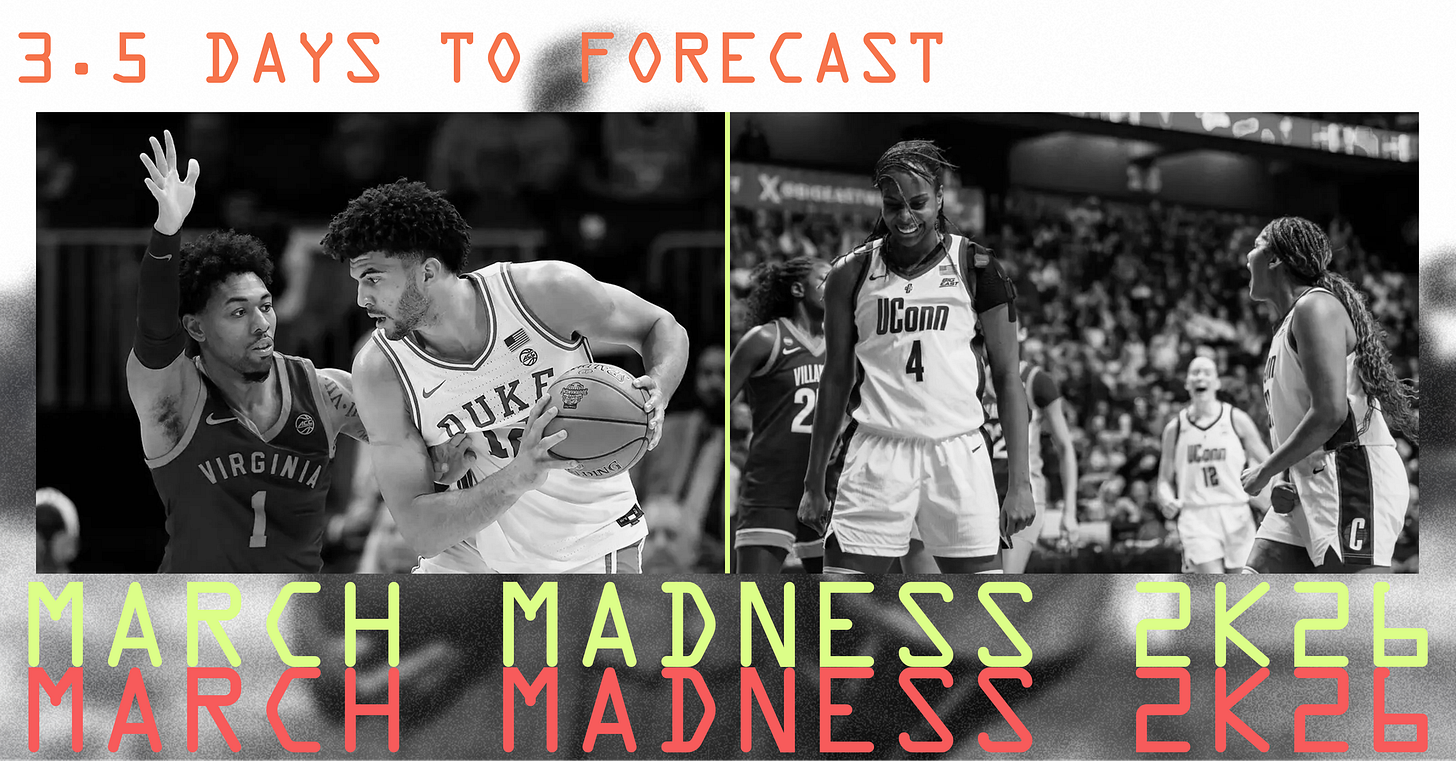
Three point five days to forecast March Madness
This project started Monday 03/16/2026 at 10:30am1. This post documents the process and the outcome of heavily-AI-assisted March Madness forecast. It is intended to be updated as days progress.A website is now live here to diagnose the forecast in real-time.I have been living in the United States for exactly twelve...
-
Neuroscience 2035: The future of neuroscience is integrative
The past decade (2015–2025) was fertile in tools, methods, and data. The challenge of the next decade is not further expansion along any one of these axes but integration across all of them: across levels of description, across species, across data modalities, and across the translational continuum1.Between 2015 and 2025,...

-
Better Judgments: How AI forecasting abilities will reshape human metacognition
L. Geay, C. J. Charpentier, and I argued recently that, with a world becoming increasingly uncertain and intractable, we want to strengthen people’s ability to evaluate the plausibility of incoming information in all its forms, and to calibrate their confidence in their judgment to the strength of available evidence –...
-
Better Judgments: What good judgments are missing
In early February 2026, my coauthors, Lucille Geay, Caroline J. Charpentier, and I published a paper in which we argue that fighting misinformation will only be achieved by rethinking judgments in terms of plausibility estimation and confidence calibration. Specifically, with a world becoming increasingly uncertain and intractable, we want to...

-
Intelligence is easy; cognition is hard
Transformer models have moderately complex organization and are readily treated as intelligent; C. elegans have well-understood neural organization we tend to disregard as meaningfully intelligent; and many systems show great performance in benchmarks while having very simple organizations.It is tempting to assume complex performance requires complex internal structure. That if...

2025
-
The mind, the brain and the network
There has been a long-standing opposition between connectionism and modularity, often framed as a dispute between learning and specialization, or between distributed representations and encapsulated systems. Essentially, both frameworks are concerned with the same question: what constrains cognition in a biological system whose basic operation is communication over networks? Connectionism...
-
Can machines think? 2.0
We have been studying human and machine cognition for more than seventy years. Mostly uninterested in the artificiality/biologicalness of its physical support, Cognition is comprehended as information processing that can be decomposed into formal systems that represent things and transform them. Turing’s imitation game (1950) has been way too much...
-
Neuroscience 2035: What the next decade looks like
This is a living post. It is not intended to be exhaustive. It is intended to document the major transformations of the field, from 2025 to 2035. Last update: February 2026.Starting with the premise that the next decade of Neuroscience will be about integration, what follows is an effort to...

-
AI Agents in the Lab: Concept Paper
Table of contents1. Why This Matters2. When Is It Time3. Blueprint4. Use Case 1: Research Discovery & Critique5. Use Case 2: Multi-Agent Simulation Sandbox6. Use Case 3: Research Documentation7. Use Case 4: Reproducibility Audit & Open Science Automation8. Use Case 5: Research Collaboration & Memory Assistant9. What This Means for Research10. NowElise Racine / https://betterimagesofai.org...

-
The public sphere is not a collection of echo chambers
I’m kickstarting with a heavyweight. The following is a translation and an expansion of an article I wrote for the French critical thinking association Cortecs.TL;DR: The public sphere is not a collection of echo chambers; listening to messages on networks creates the illusion of capturing a signal while we may...

-
Coming soon
Hi, I’m starting a Substack.I understand my relationship with writing as serving three purposes: creating knowledge via the scientific process, transmiting how the world works, and be testament to the human experience. I recently found out about Substack, and thought I should give it a try. Let’s see if it...
2024
-
Workflow for a Reproducible Research
This workflow is part of a guide about reproducibility in academic research, specifically focusing on computational analysis. It is based on my practices as a PhD and postdoctoral researcher in the academia and takes inspiration on DevOps and MLOps.It is a companion to the second part of a three-parts series about...
-
Reproducibility in Research, a practical guide (2/3): A workflow for a Reproducible Research
This guide took roots from the ethos of Open Science. In the first post of this three-part series on reproducibility in academic research, I argued that FAIR principles and stable computational environments are essential to a reproducible research. The current post delves into building a practical research workflow that relies...
-
Reproducibility in academic research (1/3): Key components of a Reproducible Research
This guide took roots from the ethos of Open Science. It is the first part of a three-parts series about reproducibility in academic research, specifically focusing on computational analysis. Any part is susceptible to changes and updates. It is based on my practices as a PhD and postdoctoral researcher in...